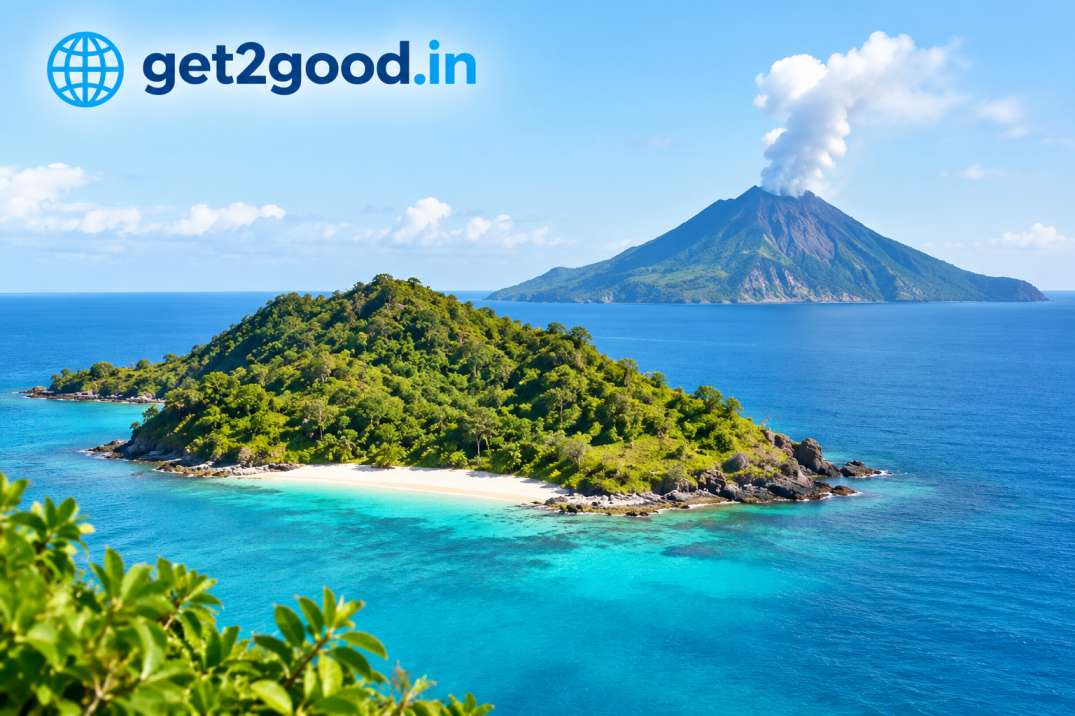
When we look at pictures of islands, we usually imagine beautiful beaches, clear blue water, green forests, and peaceful places surrounded by the sea. Many people think of islands as permanent pieces of land that remain in the same place for thousands of years.
But nature is more complicated than that.
Some islands are formed by underwater volcanoes. Others grow from coral reefs, sand, or material carried by rivers. Some islands slowly change their shape because of waves and ocean currents, while others lose land because of erosion and rising sea levels.
There are also islands that appear after volcanic eruptions and islands that gradually disappear beneath the water.
This raises some interesting questions. How does an island form in the middle of the ocean? Can an island really move? Why do some islands become larger while others get smaller? And what happens to people who live on islands that are losing land?
In this article, we will explore the science behind changing islands, discover real examples from around the world, and learn why islands are not always as permanent as they appear on maps.
1. What Is an Island?
An island is a piece of land surrounded by water.
Islands can be found in oceans, seas, rivers, and lakes. They come in many different sizes. Some are large enough to contain cities, mountains, forests, and farms, while others are so small that only a few plants or birds may live on them.
Greenland is generally recognised as the world's largest island, excluding continents under the usual geographical classification.
Other famous islands include Madagascar, Sri Lanka, Iceland, and the many islands that make up countries such as Indonesia and the Philippines.
However, islands are not all formed in the same way. Their appearance and structure depend on the natural processes that created them.
Some islands are made from ancient rocks. Others are built from volcanic material, coral, or sand.
An island's shape can also change over time. Waves may remove material from one side while depositing sand on another. Rivers can create new islands by depositing sediment, and volcanic activity can add fresh land.
This means an island is not always a fixed geographical feature. Its size and shape may change as natural forces continue to act on it.
2. How Are Islands Formed?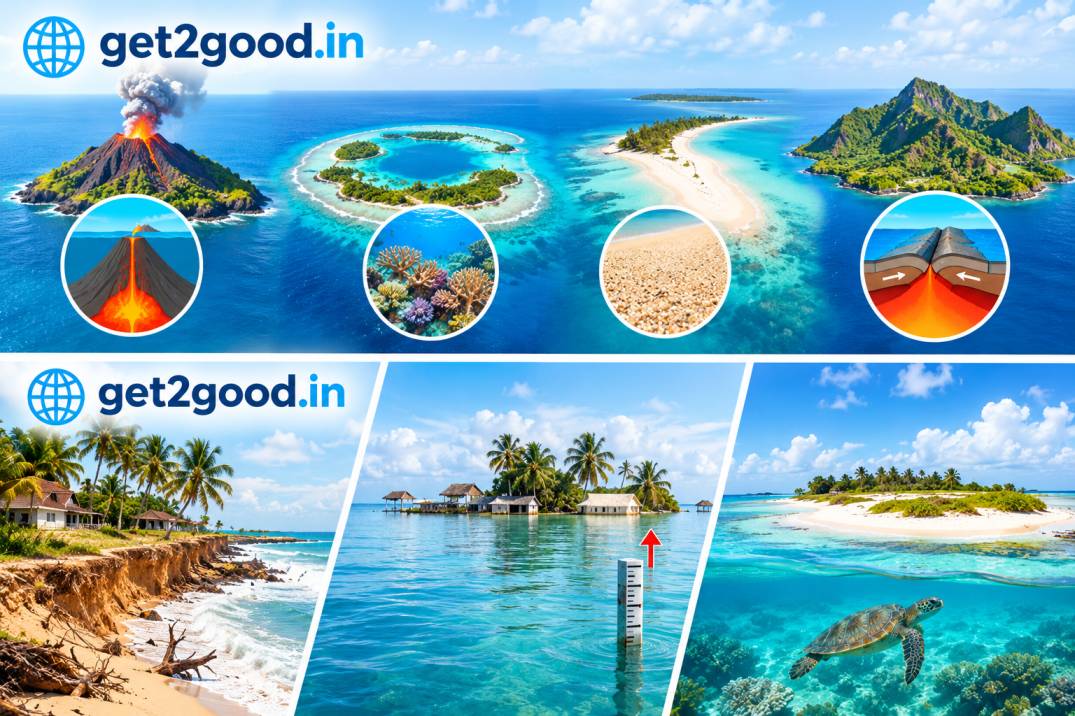
There are several ways islands can form. Understanding these processes helps explain why some islands are rocky and mountainous while others are flat and sandy.
Volcanic activity
Some islands form when volcanoes erupt beneath the ocean.
During an underwater eruption, lava rises from inside the Earth. When the lava cools, it becomes solid rock. Repeated eruptions can gradually build a volcanic mountain on the ocean floor.
If the mountain grows high enough to rise above the surface of the water, it can become an island.
Iceland is a well-known example of an island strongly shaped by volcanic activity. It lies along the Mid-Atlantic Ridge, where tectonic plates are moving apart, and it has many volcanoes.
The Hawaiian Islands also formed through volcanic activity. Their formation is associated with a hotspot beneath the Pacific Plate.
Volcanic islands can continue to grow when new eruptions add more material. However, erosion and other geological processes may gradually change their appearance.
Coral growth
Some islands develop from coral reefs.
Corals are small marine animals that build hard skeletons. Over long periods, coral structures can grow and form reefs in warm, shallow tropical waters.
In suitable conditions, waves and other natural processes can break coral material into smaller pieces. This material may accumulate and form low-lying islands.
The Maldives, an island country in the Indian Ocean, is famous for its coral islands and atolls.
These islands are particularly interesting because their landforms are closely connected to living coral reefs and the surrounding ocean environment.
Sand and sediment
Not every island needs a volcano or coral reef to form.
Some islands develop when sand, mud, gravel, or other sediment accumulates in rivers, lakes, or coastal waters.
Ocean currents and waves can transport sand from one place to another. When the water slows down or conditions change, some of that material may settle and build up.
River islands can form when sediment accumulates in channels. Coastal sand islands may develop through the movement and deposition of sand over time.
These islands can change quickly compared with islands made of solid volcanic rock.
Tectonic movement
The Earth's outer shell is divided into large sections called tectonic plates. These plates move slowly over geological time.
Their movement can raise or lower parts of the Earth's crust. In some locations, geological processes can create land that eventually becomes an island.
However, tectonic movement is usually extremely slow from a human perspective. An island formed through these processes may take millions of years to develop.
3. Can Islands Really Move?
Yes, but the answer depends on what we mean by moving.
A rocky island does not usually travel across the ocean like a boat. However, islands can change their position or shape through several natural processes.
Tectonic plates move
Some islands sit on tectonic plates that move slowly across the Earth's surface.
Because the plate moves, the island's geographical position changes relative to other locations on Earth over long periods.
This movement is usually measured in millimetres or centimetres per year, rather than kilometres in a short period.
Over millions of years, however, the movement can become significant.
Sand islands can shift
Low-lying sandy islands can change position more noticeably.
Waves, tides, storms, and ocean currents move sand around. Over time, these processes can cause an island's shoreline to retreat in one place and expand in another.
Some narrow barrier islands migrate gradually as waves and storms transport sediment across them.
From above, the island may appear to have moved, even though much of the change involves erosion and the redistribution of sand.
Floating islands
There is another interesting example: floating islands.
In some wetlands and lakes, mats of vegetation, roots, and organic material can float on the water. These floating mats may move when wind or water currents push them.
However, they are different from most conventional islands, which rest on the Earth's solid surface.
So, when we say that an island can move, we may be talking about tectonic movement, shifting sediment, or a floating mass of vegetation. These are different processes and should not be confused.
4. Why Do Some Islands Grow?
Some islands become larger because natural processes add new material to them.
The way an island grows depends on its type, location, and environment.
Volcanic eruptions add land
When lava reaches the surface and cools, it becomes rock.
Repeated eruptions can add new layers of material, making a volcanic island larger.
For example, volcanic activity has created and reshaped land in the Hawaiian Islands over millions of years.
A new eruption can also add land along an existing coastline. However, freshly formed volcanic land may be unstable and can be changed by waves and erosion.
Sand builds up along the coast
Waves and currents carry sand from one place to another.
When sand accumulates in a particular location, it can extend a beach or contribute to the growth of a sandy island.
The process depends on the balance between the amount of sediment entering an area and the amount being carried away.
If more material arrives than leaves, the island may grow. If more material is removed than deposited, the island may shrink.
Coral reefs contribute to island formation
Coral reefs can provide the material from which some tropical islands develop.
Over long periods, coral growth and the accumulation of broken coral fragments can contribute to the formation of low-lying land.
However, healthy coral reefs are sensitive to environmental conditions. Changes in water temperature, pollution, and ocean chemistry can affect the organisms that build them.
Island growth is therefore not always a simple or continuous process.
5. Why Do Some Islands Disappear?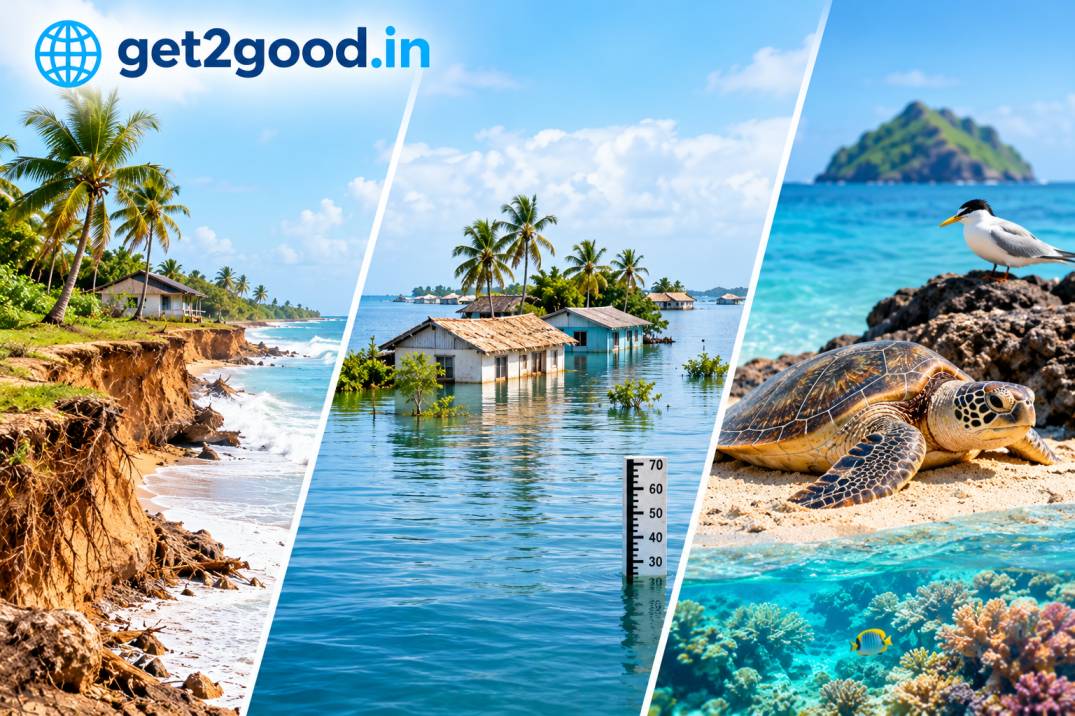
Some islands lose land gradually, while others can be heavily damaged by storms or other sudden events.
There is usually no single explanation that applies to every disappearing island.
Coastal erosion
Erosion happens when natural forces remove soil, rock, or sand from the land.
On islands, waves and currents can wear away coastlines. Strong storms may speed up the process by moving large amounts of material in a short time.
If an island loses sediment faster than it receives new material, its land area may decrease.
This is particularly important for small sandy islands because they may not have a large amount of solid rock protecting them from erosion.
Rising sea levels
When sea levels rise, low-lying coastal land can experience more frequent flooding and increased exposure to waves.
Rising sea levels do not automatically cause every island to disappear. The outcome depends on factors such as the island's height, geology, sediment supply, vegetation, and ability to adjust naturally.
Some islands may experience erosion or flooding, while others may maintain or even increase their land area if sediment accumulates.
Nevertheless, low-lying islands face serious risks when rising water levels combine with storms and other pressures.
Powerful storms
Cyclones, hurricanes, and other severe storms can reshape islands in a short period.
Strong winds and waves can remove sand, damage vegetation, flood communities, and change the shape of beaches.
A storm may cut through a narrow island, create a new channel, or carry sediment into a different location.
Although some islands can recover naturally after a storm, others may experience lasting damage.
Human activities
People can also influence island erosion.
Removing coastal vegetation, changing natural water flows, extracting sand, and building structures in unsuitable places can affect how sediment moves around a shoreline.
In some locations, these activities can make a coastline less stable.
This is why coastal planning and environmental protection are important for communities living on islands.
6. How Do Volcanic Islands Change?
Volcanic islands are among the most fascinating landforms on Earth because the same geological processes that create them can also reshape or destroy parts of them.
An underwater volcano may gradually build a mountain that rises above the ocean. Over time, new eruptions can add more rock to the island.
However, volcanic islands also experience erosion.
Rain, wind, rivers, and ocean waves gradually break down volcanic rock and carry material away.
Some volcanic islands may also collapse or experience landslides when parts of their slopes become unstable.
Surtsey: An island born from an eruption
Surtsey is a volcanic island located off the southern coast of Iceland.
It formed during an underwater volcanic eruption that began in 1963 and continued into 1967.
The eruption produced new land above the ocean surface, creating an island where there had previously been no permanent island at that location.
Surtsey is particularly important to scientists because it provides an opportunity to study how life colonises newly formed land.
Researchers have observed how plants, microorganisms, and other organisms gradually established themselves in the environment.
However, the island has also been reshaped by erosion. Waves have removed some of the loose volcanic material, showing that newly formed islands can lose land even after an eruption creates it.
Surtsey is an excellent example of how an island can be born through geological activity and then slowly change under the influence of natural forces.
7. Why Are Coral Islands Special?
Coral islands are different from many rocky islands because their development is closely connected to living organisms.
Corals are marine animals that build hard skeletons. Over time, reefs can form as coral structures grow and accumulate.
In some tropical locations, coral material contributes to the formation of low-lying islands surrounded by shallow lagoons.
The Maldives is one of the world's best-known examples of a country made up of coral islands and atolls.
What is an atoll?
An atoll is a ring-shaped coral reef, island, or group of islands that surrounds a lagoon or encloses a lagoon-like area.
Atolls often develop around volcanic islands.
Over long periods, a volcanic island may gradually sink or erode while coral reefs continue to grow in suitable conditions. The reef can remain near sea level, eventually forming a ring-like structure around a lagoon.
The exact development of an atoll depends on geological history, coral growth, and changes in sea level.
Why are coral islands vulnerable?
Many coral islands are low-lying, which makes them sensitive to flooding and changes in sea level.
Their natural ability to adjust depends partly on whether enough sediment is available to build and maintain the land.
Coral reefs are also vulnerable to marine heatwaves, pollution, and other environmental pressures.
If reef health declines, the supply of new coral material may be affected, potentially influencing the long-term stability of some island environments.
Protecting coral reefs is therefore important not only for marine life but also for the natural systems that support many tropical islands.
8. How Does Climate Change Affect Islands?
Climate change can affect islands in several ways, although the risks differ from one island to another.
One major concern is rising sea levels.
As the global climate warms, ocean water expands as it heats, and melting glaciers and ice sheets add water to the oceans.
These changes contribute to global sea-level rise.
For low-lying islands, higher sea levels can increase the risk of coastal flooding, saltwater entering freshwater supplies, and erosion during storms.
Changes in rainfall
Some islands depend on rainfall to refill groundwater supplies.
If rainfall patterns change, freshwater may become less reliable.
Saltwater intrusion can also become a problem when seawater moves into underground freshwater reserves, particularly on small islands where drinking water is stored in shallow groundwater systems.
Coral bleaching
Marine heatwaves can cause coral bleaching.
Corals live in a close relationship with tiny algae that provide much of their energy. When corals experience stress, including unusually warm water, they may lose these algae and turn pale or white.
Bleached corals are not necessarily dead, but prolonged or repeated stress can increase the risk of death.
Coral bleaching can weaken reef ecosystems and affect the marine life that depends on them.
Because coral reefs help support some island environments, their decline can have wider consequences.
Does climate change mean every island will disappear? No.
Different islands have different elevations, geological structures, and natural processes. Some can adjust to environmental changes, while others face much greater risks.
It is more accurate to say that climate change increases certain risks for many low-lying islands rather than claiming that every island will disappear.
9. Can People Save Disappearing Islands?
People cannot stop every natural change, but they can take steps to reduce some of the risks facing islands.
Protect coastal vegetation
Plants help stabilise some coastlines by holding sediment in place with their roots.
Mangroves can reduce wave energy in suitable coastal environments and provide habitats for fish, birds, and other wildlife.
Protecting natural vegetation can help support coastal ecosystems, although it cannot prevent every form of erosion or flooding.
Protect coral reefs
Reducing pollution, managing fishing carefully, and limiting other local pressures can improve the conditions in which coral reefs survive.
These measures cannot eliminate the effects of marine heatwaves, but healthy reefs are generally better positioned to withstand environmental stress.
Plan coastal development carefully
Buildings, roads, and other infrastructure can affect how waves and sediment move around an island.
Careful planning can reduce the risk of damage and help communities avoid particularly vulnerable locations.
In some places, restoring natural coastal systems may be more effective over the long term than relying only on hard structures.
Monitor changing coastlines
Scientists can use satellite images, aerial photographs, and field surveys to measure changes in island shape and shoreline position.
These observations help researchers understand whether an island is gaining land, losing land, or changing shape.
Governments and communities can use this information to plan for flooding, protect freshwater supplies, and make better decisions about where to build.
Prepare communities for future changes
Some island communities may need improved drainage, stronger infrastructure, freshwater protection, or long-term relocation planning.
The best response depends on local conditions and the risks people face.
Protecting islands requires both environmental conservation and practical planning for the people who live there.
10. Interesting Facts About Changing Islands
Here are some fascinating facts about islands and how they change.
1. New islands can form underwater.
Volcanic eruptions beneath the ocean can build mountains that eventually rise above sea level.
2. Greenland is generally recognised as the world's largest island.
Continents are classified separately, which is why Greenland is usually listed as the largest island.
3. Surtsey formed during a volcanic eruption.
The island appeared off Iceland after an eruption began in 1963.
4. Islands can change shape without moving as a whole.
Waves may remove land from one side while depositing sand on another.
5. Some islands are made partly from coral material.
Coral reefs and accumulated coral fragments contribute to the formation of many tropical island environments.
6. Atolls often surround lagoons.
These ring-shaped reef structures are among the most distinctive features of tropical geography.
7. Rising sea levels do not affect every island in exactly the same way.
The result depends on elevation, geology, sediment supply, storms, and other local conditions.
8. Satellite images help scientists track island changes.
Comparing images taken over several years can reveal changes in land area and shoreline position.
9. A new island may not remain permanent.
Islands made of loose volcanic material or sand can be eroded by waves and other natural forces.
10. Islands are constantly influenced by nature.
Even islands that appear stable are shaped by erosion, weathering, sediment movement, and geological processes.
Islands are much more than pieces of land surrounded by water. They are constantly influenced by geological activity, waves, currents, rainfall, and changes in the environment.
Some islands form through volcanic eruptions, while others develop from coral reefs or accumulated sand. Over time, these same islands can grow, lose land, or change their shape.
Surtsey shows how volcanic activity can create new land. The Maldives demonstrates the importance of coral reef
Read Mode
Why Are Some Lakes Disappearing? The Geography Behind the World's Vanishing Lakes